
Save The Tooth Or Replace It? An Endodontist’s Guide To Choosing Between A Root Canal And A Dental Implant
By Dr. Russell Kiser, DDS, MS, Advanced Dentistry & Dental Implant Center, Mansfield, Ohio

You have a tooth that is cracked, deeply decayed or aching at night, and the choice in front of you is a root canal that keeps it or an extraction and an implant that replaces it.
Most of the time the tooth makes that decision for you. Before anything else, your dentist checks whether enough solid tooth is left above the bone to rebuild and hold a restoration.
If there is, keeping your own tooth is the first option worth trying. If there isn’t, the tooth can’t be rebuilt, and replacing it is the recommendation.
I place implants, and I still open every one of these conversations by asking whether the tooth can stay.
The Short Answer
- The choice is decided by restorability, meaning how much healthy tooth and bone is left, not by which procedure sounds better.
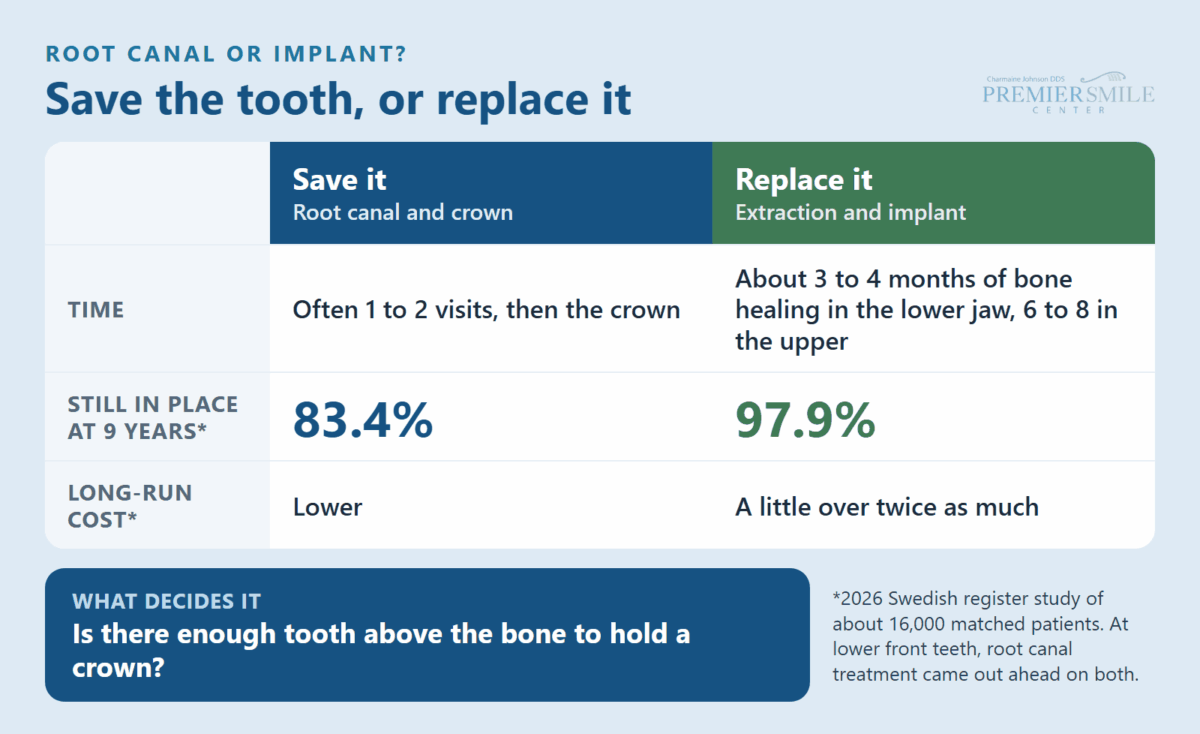
- A root canal is often finished in one to two visits plus the final restoration. An implant runs in stages across several months.
- A crack that reaches the pulp but stays above the gum line can often be treated with a root canal and a crown. A crack that runs below the gum line means the tooth comes out.
- Over the long run, saving the tooth is generally the less expensive path: in a 2026 Swedish study, the extraction and implant path cost a little over twice as much.
- When the tooth can be saved, the American Association of Endodontists advises saving it.
Table Of Contents
- Can This Tooth Still Be Rebuilt?
- What Does A Root Canal Do?
- When Can’t A Tooth Be Saved?
- What Does Replacing A Tooth With An Implant Involve?
- When Saving The Tooth Wins, And When Replacing It Does
- Which Costs More Over Time, A Root Canal Or An Implant?
- What To Ask Before Choosing A Root Canal Or An Implant
- Further Reading
- Your Next Step
Can This Tooth Still Be Rebuilt?
A tooth is worth saving when enough healthy structure remains above the bone to hold a crown, the root is whole, and the gum and bone around it are sound. That test has little to do with how much the tooth hurts.
Pain is a reason to have it checked, since it can come from a nerve that is inflamed or infected, which is treatable. A tooth that has broken off at the gum line may not hurt at all and may still be beyond saving.
Deep decay, a crack, an injury or repeated work on the same tooth can all inflame the pulp, and any of them can bring on lingering sensitivity to hot and cold, swelling or a toothache that won’t settle.
Two teeth with the same symptom can get different recommendations, depending on what is left to build on once the decay or the broken piece is cleared away.
What Does A Root Canal Do?
A root canal treats the inside of the tooth. The inflamed or infected pulp is removed, the canal is cleaned and shaped, and it is sealed, then the tooth is restored with a filling or, especially on a back tooth, a crown.
The published success rate for root canal treatment commonly runs roughly 80% to 95%, depending on how long patients were followed and what each study counted as success, and many treated teeth last a lifetime when they are restored and cared for properly.
A treated tooth is usually more brittle, which is why a molar commonly gets a crown rather than a filling. If root canals still carry a fearsome reputation in your head, watch Premier Smile Center’s video on the truth about root canals.
How Many Visits Does A Root Canal Take?
Often one or two, according to the American Association of Endodontists, followed by a visit for the crown or filling that restores the tooth. An implant runs in stages over several months instead, because the bone has to grow around the post before the permanent crown goes on.
When Can’t A Tooth Be Saved?
A crack that has reached the pulp but stays above the gum line can often be treated with a root canal and a crown that protects the crack from spreading.
Once a crack extends below the gum line, the American Association of Endodontists says it is no longer treatable and the tooth needs to be extracted. A vertical root fracture, a crack that begins in the root and extends toward the chewing surface, is one of the cracks the exam looks for.
A tooth worn down to or below the bone by decay or old dentistry can also leave too little for a crown to hold onto. A tooth extraction can’t be undone, so the decision should rest on what the exam found.
Does A Cracked Tooth Always Have To Come Out?
Not always. A crack that reaches the pulp but stops above the gum line can often be treated with a root canal, then covered with a crown that protects the crack from spreading. Once a crack runs below the gum line, the American Association of Endodontists says the tooth cannot be saved. Have a cracked tooth examined soon rather than waiting to see what it does.
Can A Root Canal Be Redone If It Fails?
Sometimes, yes. When a treated tooth does not heal or starts hurting again, retreatment can give it a second chance, and endodontic surgery, most often an apicoectomy, can treat infection that stays around the root end. The American Association of Endodontists lists two frequent causes of failure: a narrow or curved canal missed the first time, and a restoration that let saliva into the tooth.
What Does Replacing A Tooth With An Implant Involve?
An implant replaces the root as well as the crown. Because the post sits in the bone, it can help prevent the jawbone loss that often follows losing a tooth.
The implant survival rate in the published literature commonly runs above 95%, varying with a person’s health, the quality of the bone and the site in the mouth.
The trade is time and surgery. Bone grows around the implant in a process called osseointegration before the permanent crown goes on.
Healthy gums and enough bone density are part of qualifying, and smoking, uncontrolled diabetes and some medications, including certain osteoporosis drugs, can affect healing enough to change the plan.
Failure is uncommon, and it comes from infection around the implant (called peri-implantitis), from incomplete integration with the bone, or from a bite that overloads it, so pain, looseness or swelling around an implant gets checked promptly. Long-term success depends on oral hygiene and regular checkups, as it does for a natural tooth.
If the tooth is already gone, dental implants are one way to replace it, and Premier Smile Center’s write-up on choosing between an implant and a bridge walks through how that call gets made.
How Long Does An Implant Take From Start To Finish?
Plan in months rather than weeks. Osseointegration alone typically takes about three to four months in the lower jaw and six to eight in the upper jaw before the permanent crown is placed. When there isn’t enough jawbone, a bone graft may be needed first, and it adds healing time before the implant goes in.
What Hurts More, A Root Canal Or An Implant?
Patients who have a root canal are six times more likely to describe it as painless than patients who have a tooth extracted, according to the American Association of Endodontists. The implant path starts with that extraction and then adds surgery to place the post in the bone.

When Saving The Tooth Wins, And When Replacing It Does
Saving The Tooth Usually Wins When:
- Enough solid tooth remains above the bone for a crown to grip.
- The crack, if there is one, has not run below the gum line.
- The gum and bone around the tooth are healthy.
- You want this finished in fewer visits and less time, since a root canal and crown is a shorter road than implant surgery and healing.
- Smoking, diabetes that is not well controlled, or a medication that affects bone complicates healing for you, since each of those weighs on implant candidacy.
Replacing The Tooth Usually Wins When:
- The crack runs below the gum line.
- Too little tooth is left above the bone to hold a crown, even after building it up.
- Retreatment and endodontic surgery have been tried or ruled out, and the tooth is still failing.
- The tooth is already out, or is coming out for another reason, in which case the question is only which replacement fits.
When you can choose between extraction and root canal treatment, the American Association of Endodontists advises the root canal, because no denture, bridge or implant looks, feels and functions as well as a natural tooth.
I agree with that as a default. It’s a default and not a rule, and the exam is what tells us which list your tooth belongs on.
Why Would A Dentist Not Recommend An Implant?
When the tooth can still be saved, since the American Association of Endodontists advises keeping a tooth that can be restored. A dentist may also advise against an implant for health reasons: too little bone, unhealthy gums, smoking, uncontrolled diabetes or a medication that affects bone can each weigh against one.
Which Costs More Over Time, A Root Canal Or An Implant?
Replacing the tooth usually does. The American Association of Endodontists’ cost guidance is that extraction may look cheaper at first, but the implant or bridge that usually follows tends to cost more and take more appointments, so saving the tooth is generally the more cost-effective choice over time.
A 2026 study of about 16,000 matched Swedish patients found the same pattern: the extraction and implant path cost a little over twice as much as root canal treatment.
Price the whole sequence for each option. A root canal on a back tooth is usually followed by a crown, and the implant path runs in stages: the extraction, then the implant, with the abutment and crown on top of it, spread over months of visits.
On lifespan, implants did better in the same Swedish study: 97.9% were still in place at nine years, against 83.4% of the root canal treated teeth. Lower front teeth were the exception, where root canal treatment came out ahead on both survival and cost.
Implant parts can also need maintenance or replacement over time, which the first price doesn’t show. Coverage differs between plans and between the two treatments, so ask your insurer what it pays on each step before you choose.
What To Ask Before Choosing A Root Canal Or An Implant
Ask these at the consultation, for both options.
- Is This Tooth Restorable: ask what specifically the exam or the x-rays showed that says it’s savable or not.
- What Holds The Crown: ask how much tooth is left above the bone and whether it is enough to hold a restoration.
- What Happens If I Wait: ask what the tooth is likely to do over the next six months if nothing is done now.
- What Is The Whole Sequence: ask for every visit and every part from today to the finished tooth, for both options, with the price of each.
- Who Does Each Step: ask which procedures happen in that office and which are referred out.
If the answer to the first question is that the tooth cannot be saved, a second opinion is a reasonable thing to want, particularly from someone who performs both procedures.
Further Reading
- Root Canal vs. Dental Implant: Which Is Right for You?, American Association of Endodontists. The side by side version of this article from the association whose members do this work, including visits, stages and cost direction.
- Saving Your Natural Tooth, American Association of Endodontists. Read this one if you’re leaning toward extraction because it sounds simpler.
- Cracked Teeth, American Association of Endodontists. Each kind of crack explained, including which are treatable and which are not.
- Endodontic Retreatment, American Association of Endodontists. What to ask about before you let a previously treated tooth be pulled.
- Endodontic Surgery, American Association of Endodontists. What an apicoectomy is, for the case where a treated tooth still has infection in the bone around the root end.
- Implants, MouthHealthy from the American Dental Association. Plain language on what an implant is, how healing works and which health conditions complicate it.
- How Much Does a Root Canal Cost?, American Association of Endodontists. What changes the price, whether insurance covers it, and why saving the tooth is generally the more cost-effective choice over time.
Your Next Step
If a tooth is hurting, cracked or already broken down, the useful next move is an exam that answers the restorability question, because everything else follows from it.
Premier Smile Center’s team in Fort Lauderdale, which includes an endodontist and a periodontist, can make that call and handle either path in the same practice. Call (954) 566-7479 or contact the office.
If you are in north central Ohio, my own practice handles the same conversation.
About The Authors
Dr. Russell Kiser, DDS, MS practices at Advanced Dentistry & Dental Implant Center, 1221 S Trimble Rd Suite A1, Mansfield, OH 44907, (419) 756-2880. He is cross-trained in endodontics and dental surgery and places dental implants, so he treats both sides of this decision.
**Dr. Charmaine Johnson, DDS** owns Premier Smile Center at 2717 East Oakland Park Boulevard, Suite 100, Fort Lauderdale, FL 33306, (954) 566-7479, where an endodontist and a periodontist work alongside the general and cosmetic team.
General Information, Please Talk To Your Dentist: this article is general information and not a diagnosis or treatment advice. Your mouth is its own case, and whether a specific tooth can be saved is answered by an exam and x-rays, not by an article. Your situation may differ from the general information here. Talk to your dentist about what applies to you.
